History of the church and parish of Budziszewko
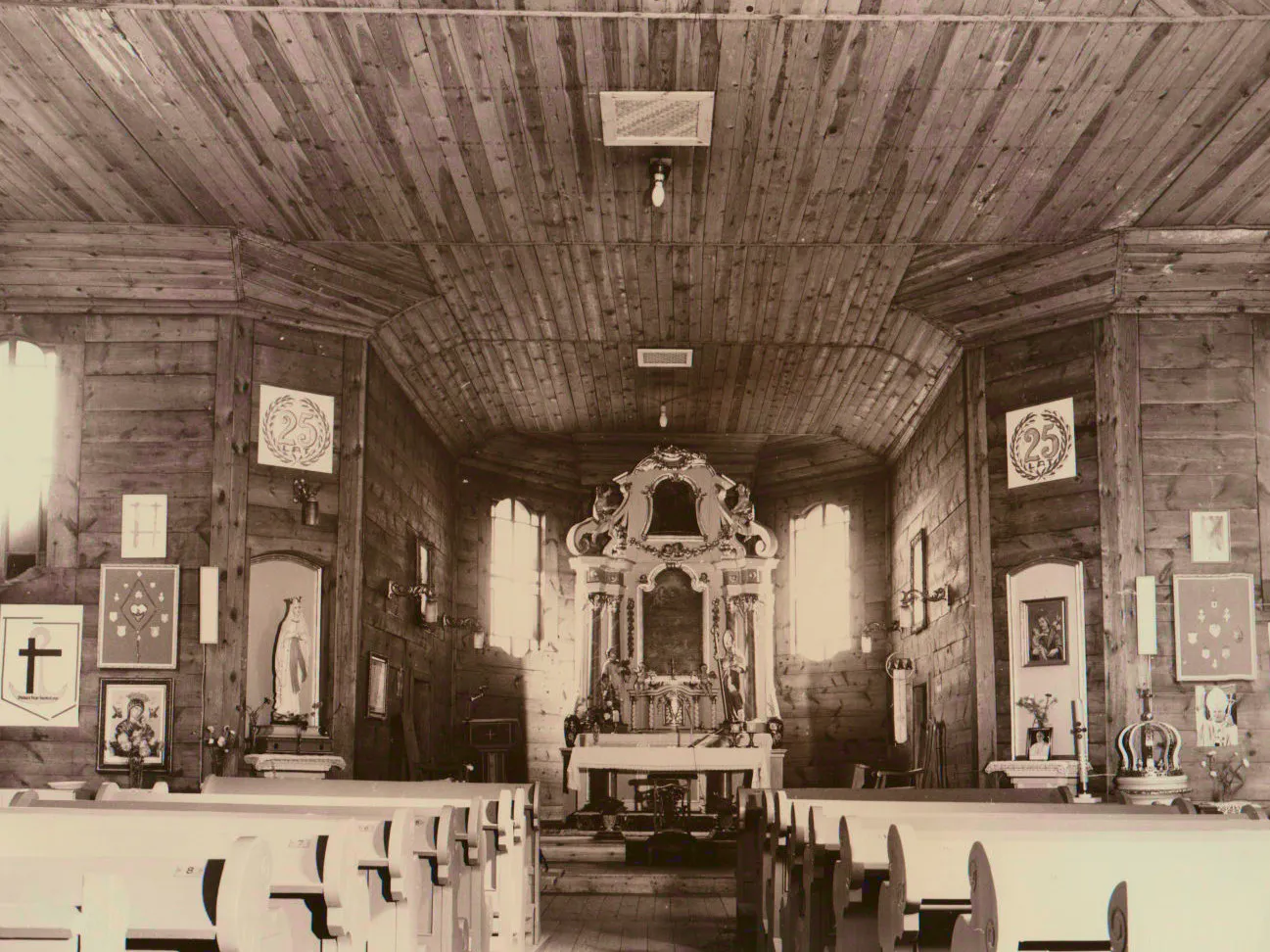
We have prepared an article presenting collected information about the parish of Budziszewko and the Church of St. James the Apostle from the 14th century to 2024. It describes the parish's founding in the 14th century and the first mention of the church in 1423, the construction of a new wooden church in 1755, the destruction caused by war, and the complete reconstruction of the church between 1958 and 1960. Learn about the actions of thirteen successive parish priests who shaped the life of the community, and how the local community fought for decades to maintain its church. A story full of determination, faith, and commitment, it demonstrates how a small parish can endure the harshest trials of time.
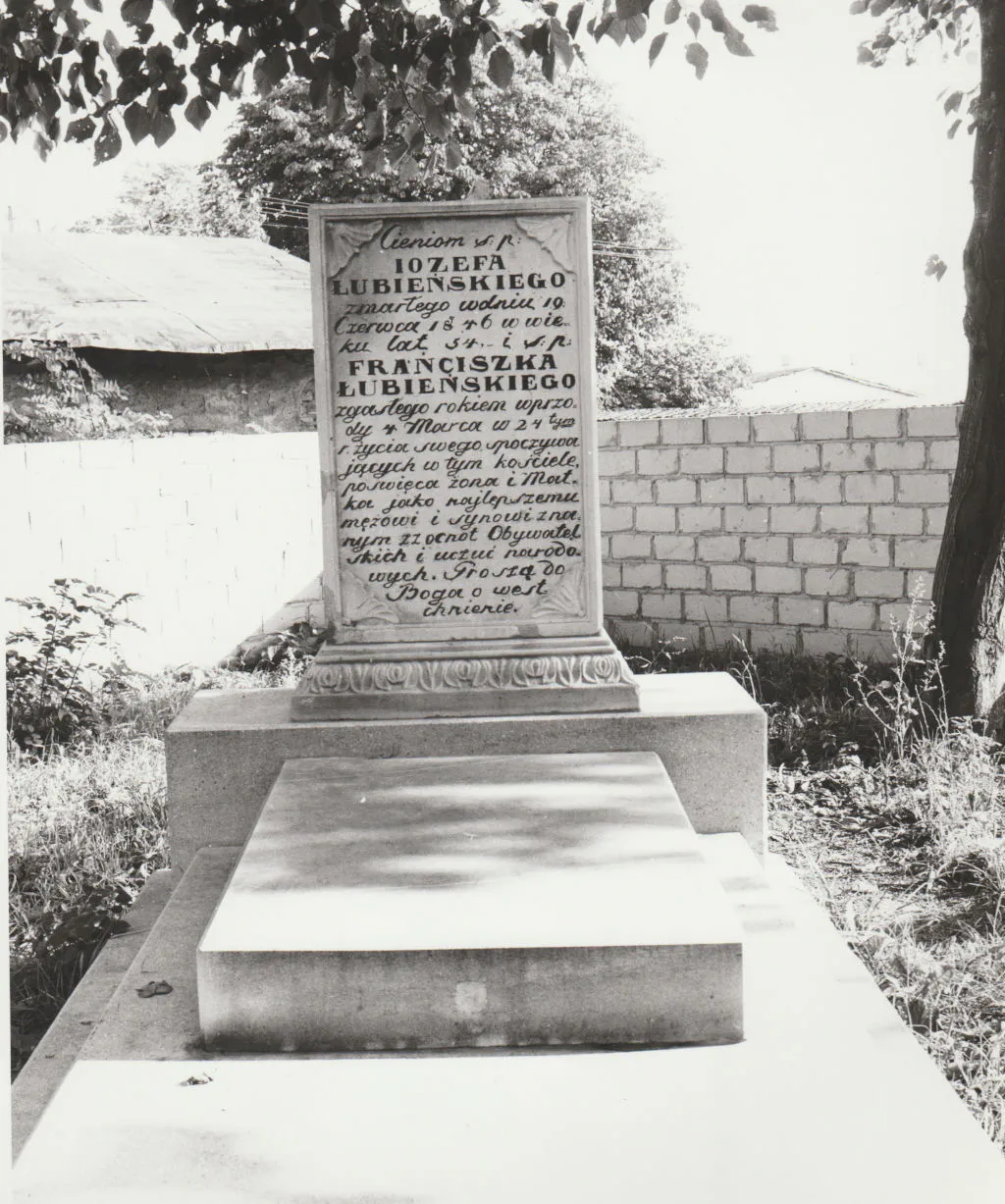
The tombstone of the Łubieński family
The tombstone of the Łubieński family
Beginnings and medieval history
The parish of Budziszewko (originally Budziszewo) was founded in the 14th century, and the first mention of a church dates back to 1423. The original church was founded by the Margoński-Budziszewski family. The first parish priest was Hanko, later Piotr. No information has been found about the subsequent parish priests, but it is known that they most likely managed the parish until 1645. Later, the parish was managed by the parish priests in Skoki. In the work "Parishes until 1530, OBORNICE DEANATE" there is an entry:
"St. James's Church, first mentioned in 1423, was probably founded in the second half of the 14th century or the beginning of the 15th century by the Margoński-Budziszewski family. Only Gorzuchowo belonged to the parish. The rectory's endowment consisted of a lan of land, Meszne, and tithes from the Budziszewo farms and the Gorzuchowo village. While the church had its own rectifiers during the Reformation period and in 1628 and 1639, from 1645 it remained under the management of the Skoczów rectifiers, without a decree of unification of the two parishes and without even a separate command. In 1797, the inspector rightly accosted the claims of the Skoczów rectifiers, who had seized the property of the Budziszewo benefice and maintained a substitute, usually a monk, at the distant local church, newly built in 1755. Therefore, the Budziszewo church was not a branch church. or sucursory, but parish under the tolerated by the ordinaries management of the Skocz parish priests" .
In 1755, the then-squire of Budziszewko, Władysław Tomicki, a Poznań sword-bearer, built a new wooden church in the shape of a Latin cross, bearing the same name of St. James. It was incorporated into the parish in Skoki. Józef Łukaszewicz's 1858 work, "A HISTORICAL DESCRIPTION OF PAROCHIAL CHURCHES IN THE FORMER DIOCESE OF POZNAŃ," includes a note about Lubowicz's visit:
"The parish church in Budziszew – the aforementioned visit – is built of wood; violent winds ripped off its roof and damaged one wall, which is why services were discontinued. The village heiress promised to build a new church, but it is unknown when she will fulfill her promise. Władysław Tomicki, Poznań sword-bearer, then the heir to Budziszew, finally built a new cross-shaped church here, which, under the title of the former church, was affiliated with the parish church in Skoki after 1758."
In 1871, thanks to the efforts of Stanisław Łubieński, the church was renovated and covered with copper sheeting. It has survived to this day, although the passing of time has not spared it further unpleasant fate. In 1878, the squire von Treskow, the new owner of the Budziszewo estate, seized the church from the Catholics and initially intended to demolish it, but instead designated it for Protestant services. By court order in 1905, the church returned to Catholic ownership and remained in use until the outbreak of World War II.
From war damage to the reconstruction of the church
During World War II, the church was closed and severely damaged. After the war, despite its very poor condition, some services were held after minor repairs, but it was treated as a branch church of the Skoki parish. On April 1, 1958, by decree of Archbishop Antoni Baraniak, the parish in Budziszewko was re-established. The parish included the villages of Budziszewko, Budziszewice, and a significant portion of Potrzanów (commonly known as Potrzanowo Kolonia, Potrzanowo State Agricultural Farm, and Potrzanowa Smolarki). A rectory was allocated to the parish, which served as a pastoral home for Evangelicals from 1905 to 1939. The parish was assigned to the Goślina deanery. The first pastor of the new parish was Father Henryk Buchalski, who had been vicar of the parish in Skoki before the parish was established but served as the church manager in Budziszewko. In the post-war period, one Mass was celebrated until 1958. The parishioners welcomed the new priest very warmly.
From the outset of his administration of the new parish, the parish priest made efforts to renovate, or rather rebuild, the dilapidated church building. Thanks to the parish priest's enormous commitment and determination, renovations to the church began in 1958.
Before the renovation work began in 1958, the Committee for the Protection of the Historic Church of St. James the Apostle in Budziszewko was established and approved by the Metropolitan Curia in Poznań and the Presidium of the District National Council in Oborniki. The committee included Marian Rymarski, Stanisław Pinczyński, Felicja Wilkowska, Wacław Lichota, Maria Frydrychowska, Jan Łubianka, Wincenty Poznańik, and Edmund Szymański. All parishioners contributed to the reconstruction work to their abilities. The parish priest coordinated the work, and the main specialists were Mr. Alfons Pawołek and Mr. Stanisław Nowak, also parishioners. During the church renovation, Mr. and Mrs. Józef and Felicja Wilkowski provided a large room – a community room – which was designated as a catechism center, but services were also held there. The church renovation involved the complete demolition of the old building, laying new foundations, excavating the earth and constructing a basement beneath the entire building, and then rebuilding the church in its original shape and size. Steel elements were also used in the construction of the structure. A significant portion of the wooden elements—wooden beams—were restored and reused for the new construction. The remaining missing elements were purchased. Bricks recovered from the demolition of ruined buildings, often built after wartime, were used to construct the foundations and basement walls.
The main construction work lasted two years. Some of it was carried out at night to allow for unauthorized changes outside the design or to use materials from so-called other sources. On December 24, 1960, Midnight Mass was celebrated in the new church, although finishing work continued for many years.
In addition to the church's reconstruction, work was underway almost simultaneously on constructing a fence around the parish cemetery. Thanks to the efforts of Parish Priest Buchalski, 0.40 hectares of land were acquired for the cemetery. Parishioners collected bricks from the demolition site, cleaned them, and together built a fence surrounding the cemetery.
At the end of 1961, the parish priest changed. Father Henryk Buchalski was transferred to another parish, and Father Antoni Nowak took over as pastor until 1964. During his term, the parish was visited by Bishop Tadeusz Eter of the Poznań Curia.
In 1964, Father Henryk Kujawa was appointed parish priest and led the parish for 10 years, until 1974. During his tenure, changes were made to the celebration of Holy Mass, including the reconstruction of the chancel. An altar facing the congregation was built. The priest also faced the congregation. Holy Mass was celebrated in Polish, replacing the former Latin language. On January 1, 1972, the Budziszewko parish was assigned to the Rogoziński deanery and expanded to include the village of Studzieniec. On May 20 of that year, Bishop Tadeusz Eter visited the parish again.
In the years 1974–1975 the parish was administered by parish priest Henryk Godek, and in the years 1975–1976 by parish priest Marian Marcinkowski. In 1976, during the summer holidays, the parish was administered by priest Stanisław Konic, parish priest of the Parish of the Holy Spirit in Rogoźno.
In September 1976, a new pastor, Father Władysław Kasprzak, arrived. He took over the parish for five years. During his tenure, the rectory underwent a thorough renovation, including the replacement of the roof, and electric heating was installed in the church. The parish was visited by Bishop T. Eter in 1977 and Bishop Marian Przykucki during the reception of a copy of the painting of Our Lady of Częstochowa, which was traveling around Poland. From 1981 to 1985, the parish was administered by Father Aleksy Mercik. These years brought the renovation of the altars, the Stations of the Cross, the pews, and the choir loft. After the renovations, the parish was visited by Bishop Zdzisław Fortuniak. From 1985 to 1989, the parish priest was Father Zygmunt Napierała. Under his supervision, in 1985 the church's interior façade was renovated and a new lightning protection system was installed, and in 1988 the church was covered with zinc sheeting. In 1987, Bishop Stanisław Napierała visited the church.
The years 1989–1997 were marked by Father Wojciech Murkowski's leadership of the parish. Parishioners also remember him as an active biotherapist. Thanks to his efforts, on February 1, 1990, after necessary adaptation work had been completed in the premises of the former community center in Studzieniec, a chapel was established. In 1992, the Rogoźno municipal authorities transferred ownership of the developed property – a plot of land and a chapel in Studzieniec – to the Budziszewko Parish. In 1991, part of the church's basement was developed – a pre-funeral chapel was established in the eastern section. An additional entrance to the basement was constructed. Meanwhile, the electrical system in the church was replaced, and the central heating system in the rectory was replaced. On May 1, 1992, by decree of Archbishop Jerzy Stroba, a significant portion of Potrzanów – the aforementioned Smolarki and Kolonia – was separated from the parish, re-incorporating them into the Skoki Parish. On June 23, 1992, the parish was visited again by Bishop Zdzisław Fortuniak. April and May 1993 were a period of renovation for the cemetery, with the brick fence being plastered. In June of that year, 11 new stained-glass windows were installed in the church.
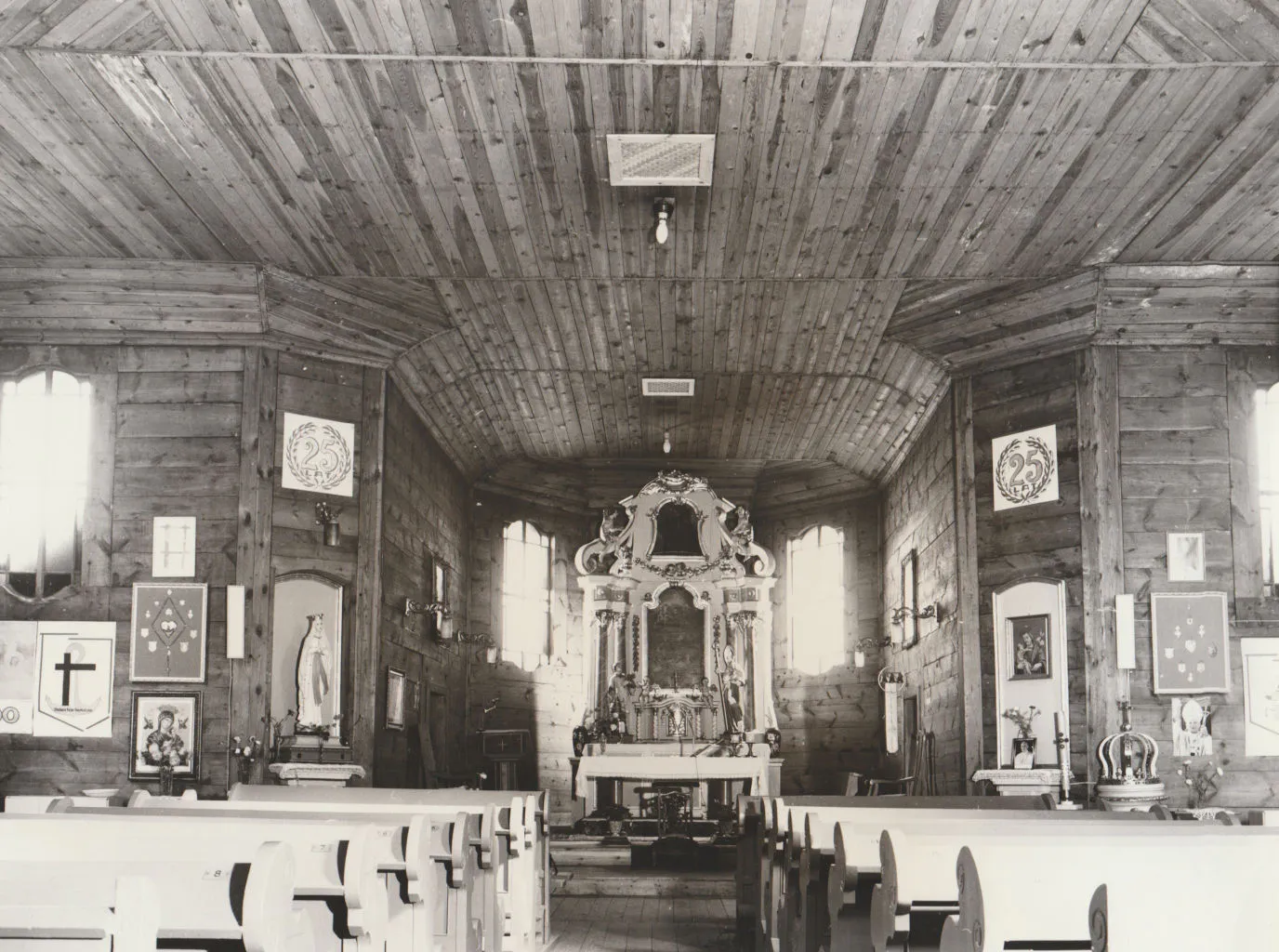
The interior of the church in the 20th century
The interior of the church in the 20th century
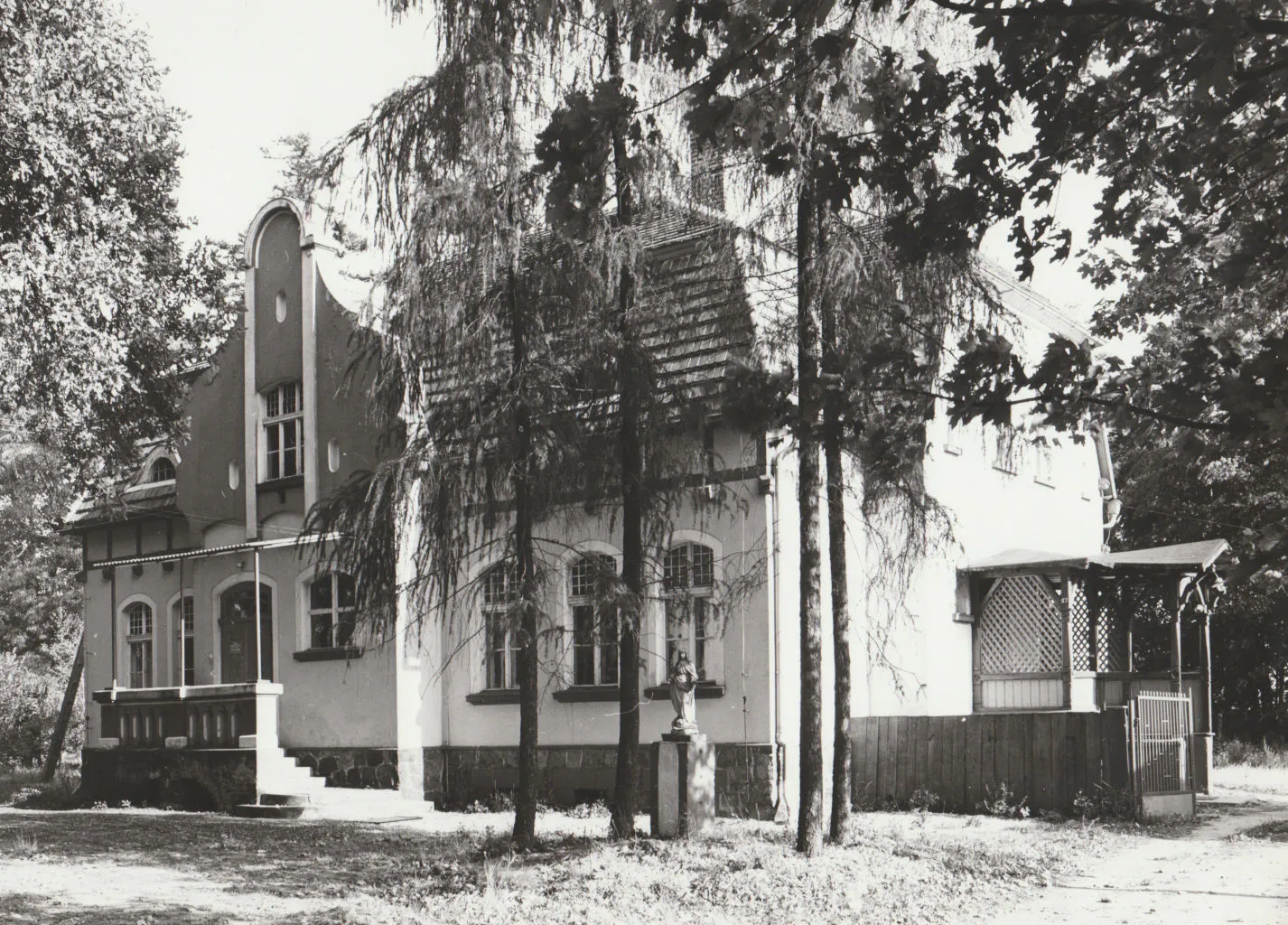
The rectory building located next to the Church of St. James in Budziszewko
The rectory building located next to the Church of St. James in Budziszewko
Investments and development today
July 1, 1997, brought another change of parish priest, with Fr. Jerzy Hakowski taking over. During his 10 years in office, a number of investments were made, including: repairing the fence around the church, replacing the gate in front of the church, repairing the cemetery gate, draining the church, covering the ground floor windows, and in Studzieniec, restoring the chapel facade and removing trees growing near the church and posing a safety hazard. A portion of the land was also designated for a parking lot in front of the church. In 2007, a new cross was erected at the fork in the road near the church.
Since April 2004, the Budziszewko parish, along with the entire Rogoziński deanery, has been assigned to the Archdiocese of Gniezno. That same year, Bishop Bogdan Wojtuś visited the parish. On September 1, 2007, Parish Priest Grzegorz Kuliński took over the parish's administration. Renovations to the rectory and the church interior continued. In 2007–2008, a parking lot was constructed in front of the church, and a sidewalk was laid from the rectory to the church, along with a sidewalk in the cemetery.
On September 6, 2008, the 50th anniversary of the revived Budziszewko Parish was celebrated. Archbishop Henryk Muszyński officiated the ceremony. This year, a live nativity scene was organized for the first time for Christmas. Animals featured in the nativity scene included a horse, sheep, goats, rabbits, and pigeons. In 2008-2009, work was carried out in the church's basement. New windows were installed, walls were plastered, and the floor was poured, allowing this part of the church to be used for liturgical services, particularly during Holy Week. The ceiling in the chapel in Studzieniec was also renovated, and a parking lot in front of the chapel was created. As part of the Ministry of Culture and National Heritage's "Securing Wooden Churches" project, alarm sensors were installed in the church in 2010. In 2011, the church bells were renovated and an electric drive was installed. In 2011–2012, further repairs and renovations were carried out on the church and rectory, as well as the renovation of the fence at the rectory on the western side and the construction of a new one on the northern side.
From 2015 to 2022, the parish was administered by Father Przemysław Franek. His tenure coincided with a significant decline in Catholic activity in Poland, partly due to the COVID-19 pandemic, which in turn contributed to a decline in income (contributions). Parish councils organized dances to support the parish treasury. Despite financial difficulties, in addition to ongoing maintenance of the church, chapel, and cemetery, exterior conservation work was carried out, along with additions recommended by the conservator. A new roadside cross was erected in front of the bridge over the lake and the small Wełna River.
As of September 2022, Father Canon Adam Czechorowski has been appointed pastor of the Budziszewko parish, concurrently serving as pastor of the Holy Spirit Parish in Rogoźno. The pastor is permanently attached to the parish in Rogoźno, where he lives and maintains an office. This situation has become unfavorable for the parish in Budziszewko. Services in Budziszewko and Studzieniec have been limited. The rectory is unoccupied. The parish still exists, and the parishioners care for the church. In 2023, at the recommendation of the State Fire Service, an external power switch was installed, and in 2024, another investment was made: replacing the gutters on the church and inspecting the roof, which involved bending and straightening the zinc sheeting. The statue of the Virgin Mary was restored, a new missionary cross was erected, and the chandeliers and wall lamps in the church were refurbished.
On the church grounds there are:
- Figure of the Virgin Mary from 1888,
- Missionary cross erected in 2024 (previously it stood next to the church on the south side),
- The tombstone of Józef and Stanisław Łubieński and Konstancja Łubieńska (the name Konstancja is missing from the gravestone),
- Tombstones of Antoni Klinger and Józef and Henryk Pilecki, murdered by the Nazis.
Footnotes
Kościół parochialny
kościół parafialny
Utrzymać substytuta
utrzymać pełnomocnika
Meszne
nazwa podatku przysługującego parafii za odprawiane msze, pobieranego głównie w zbożu
Łan
jednostka powierzchni około 0,40ha
Beneficjum
dobra ziemskie przydzielone osobie za wykonywanie powierzonych obowiązków
Sukurs
wsparcie, pomoc
Afiliowany
przyporządkowany
 Sołectwo Budziszewko