It's worth noting that what you're reading is only a condensed portion of the rich history of our village. This is just the beginning. We invite you to read more articles soon. We'll gradually expand our collection of information and uncover new chapters in Budziszewko's history.
660 years of the Royal Village of Budziszewko – discovering the rich history of our region
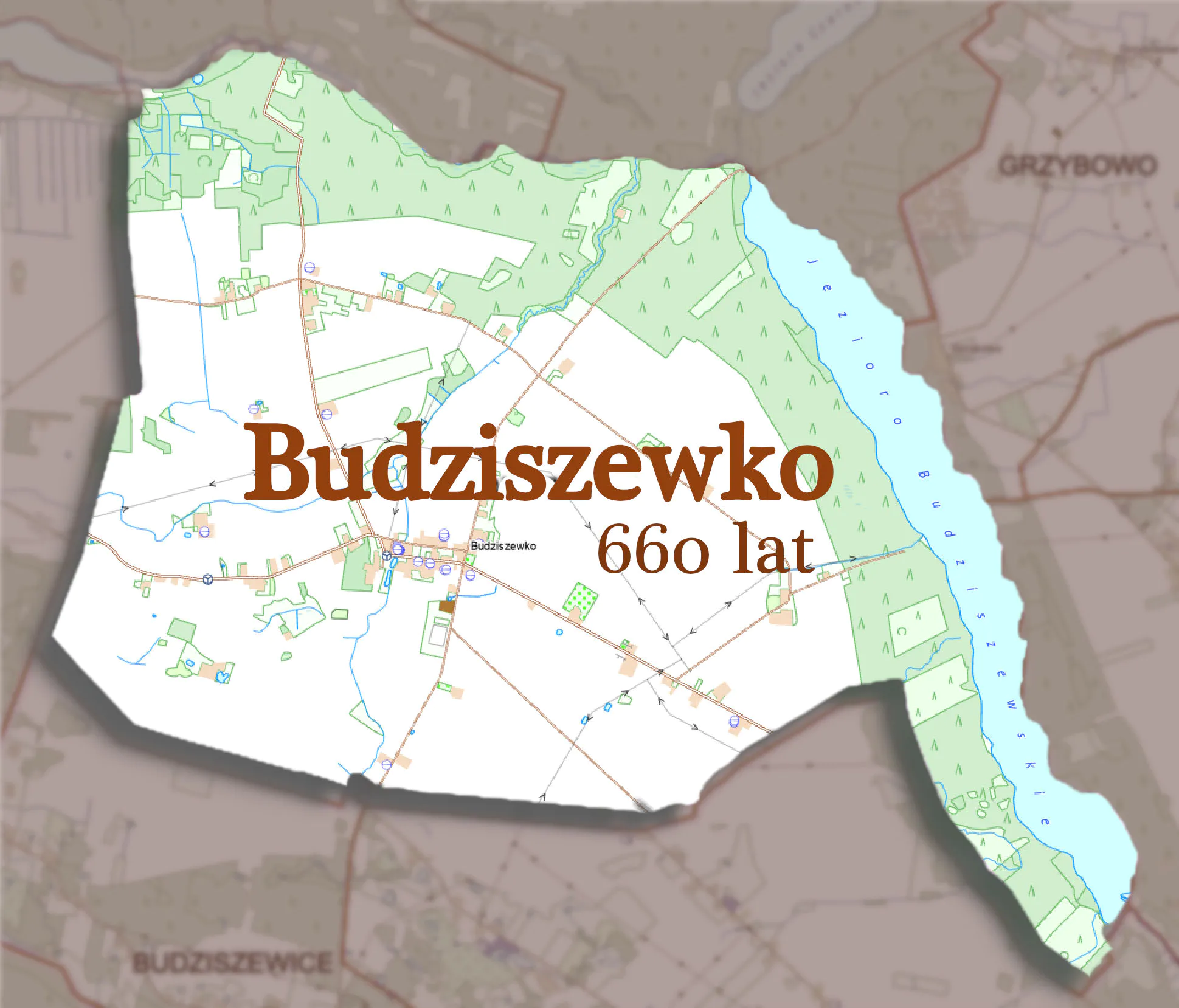
The Budziszewko village boasts a rich, centuries-old history, which we want to preserve and pass on. For this reason, we have decided to honor the 660th anniversary of the Royal Village of Budziszewko by preparing a short historical outline. Its author is Mr. Gustaw Wańkowicz, M.Sc., who delved into our village's past with a group of people involved in Budziszewko's present-day life, led by village head Szymon Witt. The article provides a cross-section of the village's development, from the earliest settlements, through the Middle Ages, World Wars I and II, to the postwar period.
The history of Budziszewko, or rather the area, based on archaeological excavations
Although 2025 marks the 660th anniversary, 1365 is not the actual year of the village's founding. The village existed much earlier. Archaeologists report that the earliest traces of settlement in this area—two camps—date back to the Paleolithic period, the Old Stone Age, which dates back to approximately 10,000–8,000 BC. This is evidenced by excavations that indicate the use of stone tools. Other excavations, dating from more recent times: 3500–2500 BC, or the even more recent period of the Bronze Age, 1000–650 BC, attest to a community of people living in our area. During the Stone Age, these areas were inhabited by groups of hunters, fishermen, and gatherers, who left traces in the form of flint tools and camps. In the later Bronze and Iron Ages, settlement began to develop in this area: residents were already cultivating the land and raising animals. Thanks to archaeological research and preserved historical records, we learn that the area of present-day Budziszewko also played an important role in the history of local settlement.
Later times – the beginnings of the Polish state
Moving on to the medieval period: the 10th-12th centuries, or 1,000 years ago, a ring-shaped hillfort existed in this area. According to local accounts, or perhaps legend, the hillfort was leveled by the Germans during the occupation to erase any traces of Polish or Slavic settlement, and the topsoil was removed for research. By the early Middle Ages, Budziszewko was already a knightly village in Poland, ruled by the Grzymała family. The settlement became a center of trade and crafts. Resident artisans, such as blacksmiths, potters, and weavers, gained renown throughout the region. In written sources, the first year to appear is 1365, 660 years ago. King Casimir III the Great "granted," or rather exchanged, the village of Budziszewko, along with other adjacent estates, to Przecław of Margonin, a Poznań judge descended from the Margoński family. The word "granted" is used here for a reason; it proves that an organized village already existed. Hence, records indicate that the village was originally royal property until 1365. From then on, for two centuries, the village became the family home of one of the branches of the Margoński family, who adopted the surname Budziszewski, either from the name Budzisz or the name of the village. Interestingly, surnames in Poland were used only among the upper classes, but only from the 14th century onward. Yet, the village was called Budziszewo and lasted until the 1920s, during the interwar period. Historian Professor Tomasz Jurek has demonstrated that the modern name "Budziszewko" was already in use in the Middle Ages. Older residents of Budziszewko continued to use the name Budziszewo long after World War II.
The village's owners, the Budziszewskis, commissioned the construction of a church as early as 1423. A parish school was established next to the church, mentioned in historical sources in 1515. In 1509, the village had an inn, likely built along the Gniezno-Rogoźno trade route to accommodate traveling merchants. Routes at that time mostly ran along rivers and lake shores due to the flat terrain. The inn in Budziszew, along with the inn, stable, and well, were located on the site of the current Lochdański estate – near the distillery. In 1510, there was also a farm here. The Budziszewski family flourished, and in 1528, Barbara Budziszewska divided the estate among her five sons, which began the estate's decline and debt.
The period of the 18th century and the Prussian partition
In the 18th century, the Budziszewo estate was acquired by the Tomicki family, of the Łodzia coat of arms. The Tomicki family was a large, noble, and wealthy family from Greater Poland. In 1755, Władysław Tomicki, a Poznań sword-bearer, built a new wooden church in the shape of a Latin cross, bearing the same name, St. James the Apostle. This means the first church survived for 330 years. From 1770, Budziszewko was already owned by the Łubieński family, of the Pomian coat of arms. From 1827, the estate was owned by Józef Łubieński and Konstancja née Bojanowska from Kiączyn, Szamotuły County. Besides Budziszewko, the Łubieński estate included four villages, dominions, and farms: Gorzuchowo, Kolędzin, and Kostusin – a total of 5,693 morgens, or approximately 1,450 hectares. Stanisław Łubieński built a distillery – the year 1877 is still inscribed on the chimney. He also renovated the church, which survived until 1959. Unfortunately, Stanisław Łubieński fell into debt and was forced to sell Budziszewko in 1878. This was the time of the Partitions of Poland, and the Budziszewko area fell under Prussian rule. The estate was then purchased by Albrecht Treskow, a German cavalry captain from Biedrusko, a descendant of von Treskow, a shareholder in the Berlin bank.
An extraordinary woman of the 19th century – Konstancja Łubieńska
She came from the Bojanowski family, the daughter of Bogusław Bojanowski, Stanisław August's chamberlain. She graduated from a boarding school in Dresden. She was renowned for her talent, beauty, and wit, but also excellently educated and mannered. She married Józef Łubieński, a captain in Napoleon's army 20 years her senior, and settled on an estate in Budziszewko in 1827. With Józef, she had five children: Waleria, Maria, Franciszek, Bogusław, and Stanisław (whom we mentioned in the paragraph above). In 1831, she met Adam Mickiewicz, who was staying with her sister Antonina in Śmiełów. Mickiewicz became Maria's godfather. The parish records in Skoki contain a note from the parish priest, Fr. Borowski: "On September 26, 1831, I performed the baptismal rites for a child named Maria, daughter of Józef Łubieński and Konstancja née Bojanowska, the legal spouses. Adam Mickiewicz, the poet, and Marianna Wodecka were present."2 The baptism took place in Budziszewko. Konstancja maintained regular contact with Adam Mickiewicz. They began an affair. She was ready to leave her husband and children for the poet. When the poet settled in Paris, she supported him financially with considerable sums. She was involved in clandestine independence activities. She was engaged in social and literary work. She wrote her works, but also translated German and French editions. In 1842, she founded an orphanage in Marcelin (now part of Poznań). After the death of her husband Józef (in 1846), she remarried to Wandalin Wodpol, the tutor of her children. She was the owner of today's Budziszewko and Marcelin. In Marcelin, she founded a school for girls in economics. Upon hearing of Adam Mickiewicz's death in November 1855, she traveled to Paris, where she attended the poet's funeral. She died 12 years later and was buried in Budziszewko.
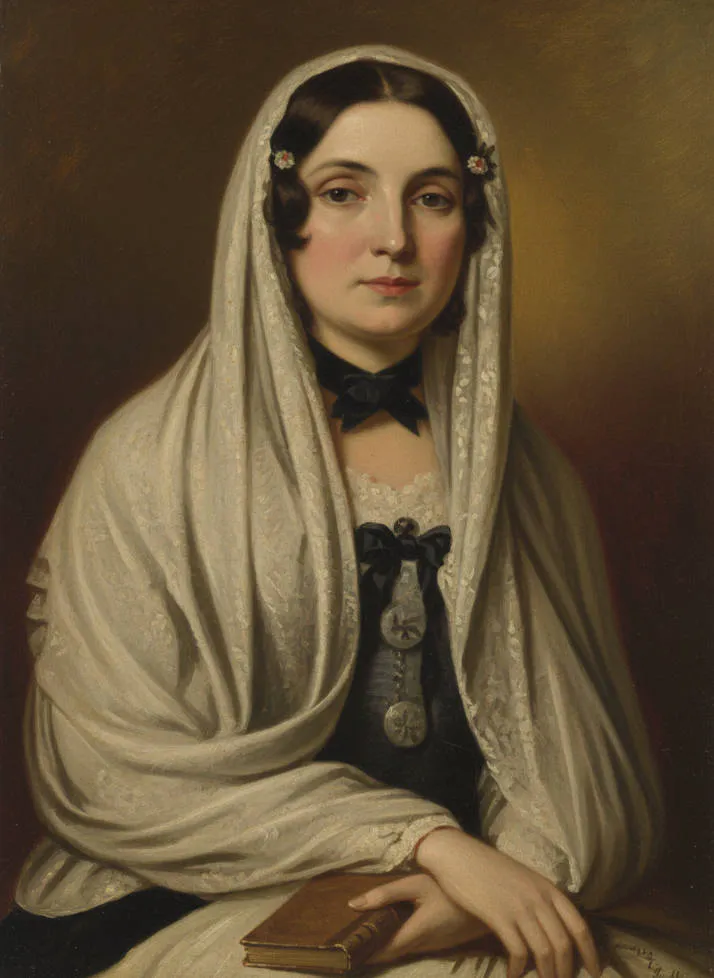
Konstancja Łubieńska - painting based on a photograph by St. Brzozowski (Warsaw)
Konstancja Łubieńska - painting based on a photograph by St. Brzozowski (Warsaw)
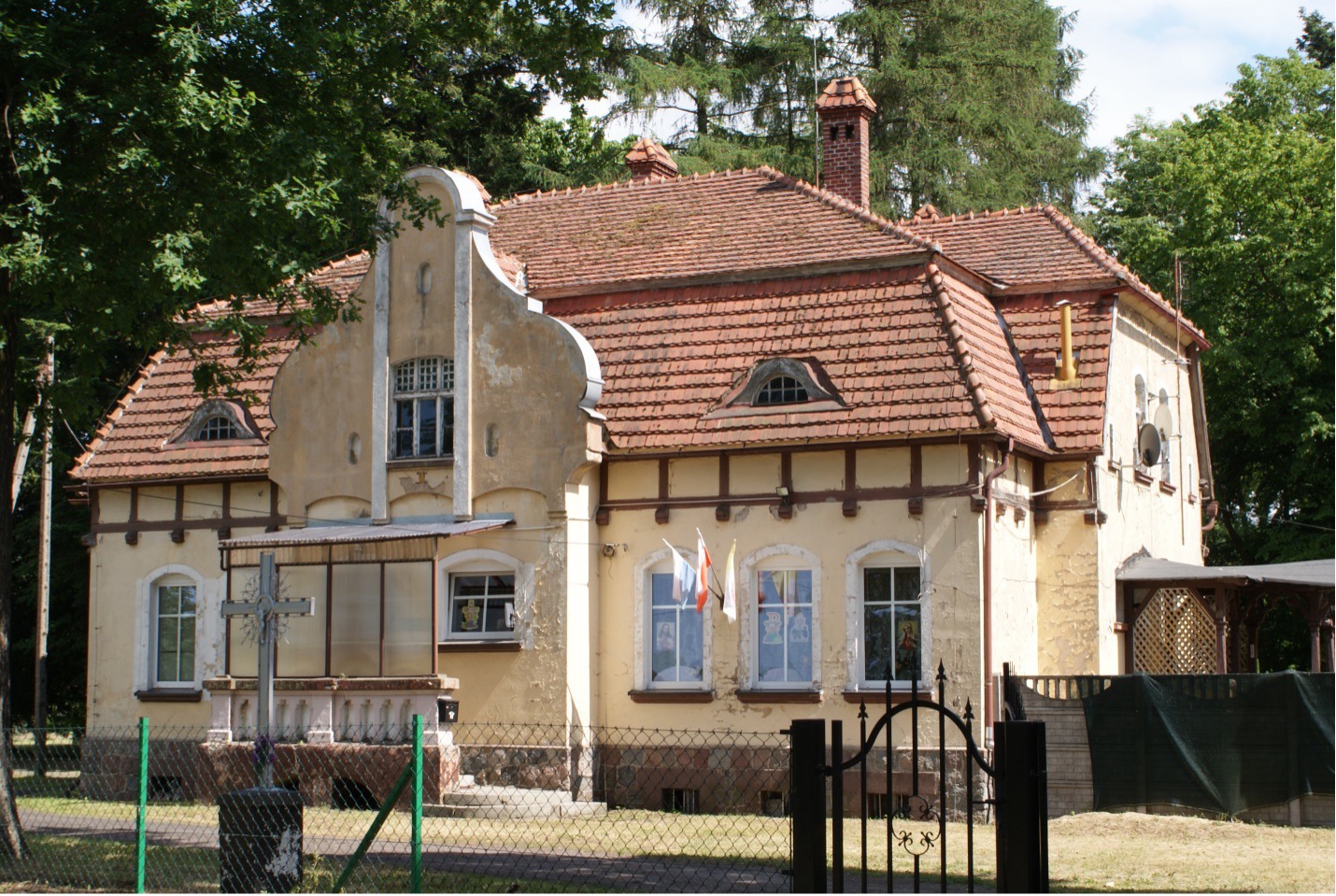
The rectory building since 1958
The rectory building since 1958
German colonization and religious conflict in Budziszewko
Albrecht Treskow became the owner of the palace and distillery, which led to the formation of a German joint-stock company. In addition to producing spirits, the distillery also milled grain for animal feed and purchased and processed milk. Albrecht designated the purchased property for colonization purposes. The entire estate, including Budziszewice, amounting to several thousand hectares, was parceled out. At the time, Budziszewice was a village established for the workers of the Budziszewo estate and existed as early as the 18th century as Olędry Budziszewskie. The land was purchased by German colonists of the Evangelical faith. The arriving Germans lacked the facilities for religious worship. Treskow initially intended to demolish the church, but ultimately designated it for Evangelical services. Catholics, seeking to regain possession of the church, filed a complaint with the court, and in 1905, the court ruled that the church was restored to the Catholics and reconsecrated. The Evangelicals demolished the ceilings in the central part of the palace for religious worship, constructing a two-story chapel with a choir and two adjoining rooms. In 1905, a pastor's house with an interesting architectural silhouette was built on the northwest side of the park. A bell tower was built on the slope next to the palace, but in 1945 it was relocated next to the church. After the war, the pastor's house was inhabited by Polish families, and after the parish was reestablished in 1958, it became a rectory.
Crimes, displacements and occupation – World War II in Budziszewko
After the end of World War I and Poland regained independence, some Germans returned to the Reich, selling their farms. These farms were purchased by Poles. During the interwar period (1919-1939), the village of Budziszewko was inhabited by 37 German families (including 31 farmers) and 38 Polish families (including 24 farmers), as well as 11 Polish families living in substandard bailiffs' houses. The outbreak of World War II brought many changes and atrocities to the lives of Budziszewko's residents. On September 8, 1939, Nazi militiamen murdered five Poles in a field a few dozen meters from the village, near the road to Budziszewice:
- Antoni Klinger – village head,
- Józef Pilecki – farmer,
- Józef Pilecki's son – Henryk,
- Florian Miśko - retired head of the Municipal Court in Rogoźno,
- one unidentified person.
This place is commemorated with a cross and an information plaque.
On the night of September 25, four young men, residents of Budziszewko, were arrested:
- Jan Chlebda,
- Józef Gajewski,
- Stefan Mikulski,
- Józef Pilarski.
They were led into the forest and shot or deported. After the war, despite extensive searches, their graves were not found. The farmers were evicted, and their farms were taken over by the Germans. On many farms, Poles were employed as cheap labor, stripped of most rights, while the displaced people moved deeper into Poland, namely to the General Government. During the first years of the occupation, a significant number of trees were cleared in the middle of the village park near the Łubieński Palace to clear land for the construction of buildings for a girls' economic school. This school prepared the girls to be good and true Germans, housewives, and wives. These were wooden barracks, constructed from prefabricated elements on a solid foundation. After the war, the barracks were demolished by the local population. In subsequent years, a school was established in the palace, and the aforementioned chapel room served as a school club and village dance hall for the residents. Preparing girls to be good and true German women, housewives, and wives. Legend tells of a canal running from the palace to the pond. As far as we know, the canal existed, but it was a drainage channel.
Towns located in the area of today's Budziszewko
Gorzuchowo is linked to the history of Budziszewo. It appears in the description of the Budziszewo Parish and in the description of the property belonging to the owner of Budziszewo (Budziszew). This is a defunct village, also mentioned as a village council, located north of the road from Studzieniec eastward to the former Władyszyn.
Within the area of present-day Budziszewko, there were farm names, perhaps villages, such as Kostusin (Kostuszyn), Władyszyn, and Kolendzin (Kolędzin). These names have since disappeared, having been removed from the census as part of the standardization of place names. The standardization of geographical names in Poland was carried out as early as 1934 and in the years following World War II, based on regulations of the Council of Ministers. Maps from subsequent years include:
- 1797 – Gorzuchowo, Budziszewo, Władyszyn, Kostusin and Kolendzin
- 1888 – Gorzuchowo, Budziszewo, Władyszyn and Kolendzin
- 1921 – Budziszewo, Władyszyn, Kolendzin and Kostusin
- 1934 – Budziszewko, Władyszyn
- currently – Budziszewko.
Various historical accounts state that Albert Treskow acquired the Budziszewo estate in 1878. It should also be noted that in 1923 the estate was owned by W. Degner, and in 1924, under his leadership, the estate's land was divided among German colonists. According to residents who remember the period of World War II, Dreger was also the village head of Budziszewko during the occupation, but there is no confirmation that this was the same person.
The Historical and Geographical Dictionary of Polish Lands in the Middle Ages lists names associated with Budziszewko over the years. They include:
- 1391 – Budeszewo
- 1399 – Budzisszevo
- 1400 – Budzeszewo
- 1408 – Budziszewo
- World War II – Buschdorf
- currently since 1920 – Budziszewko.
Below, on the maps of the German copy and the current schematic Polish copy, the individual names of the town, settlement or farm and the mentioned strongholds are located.
Gallery
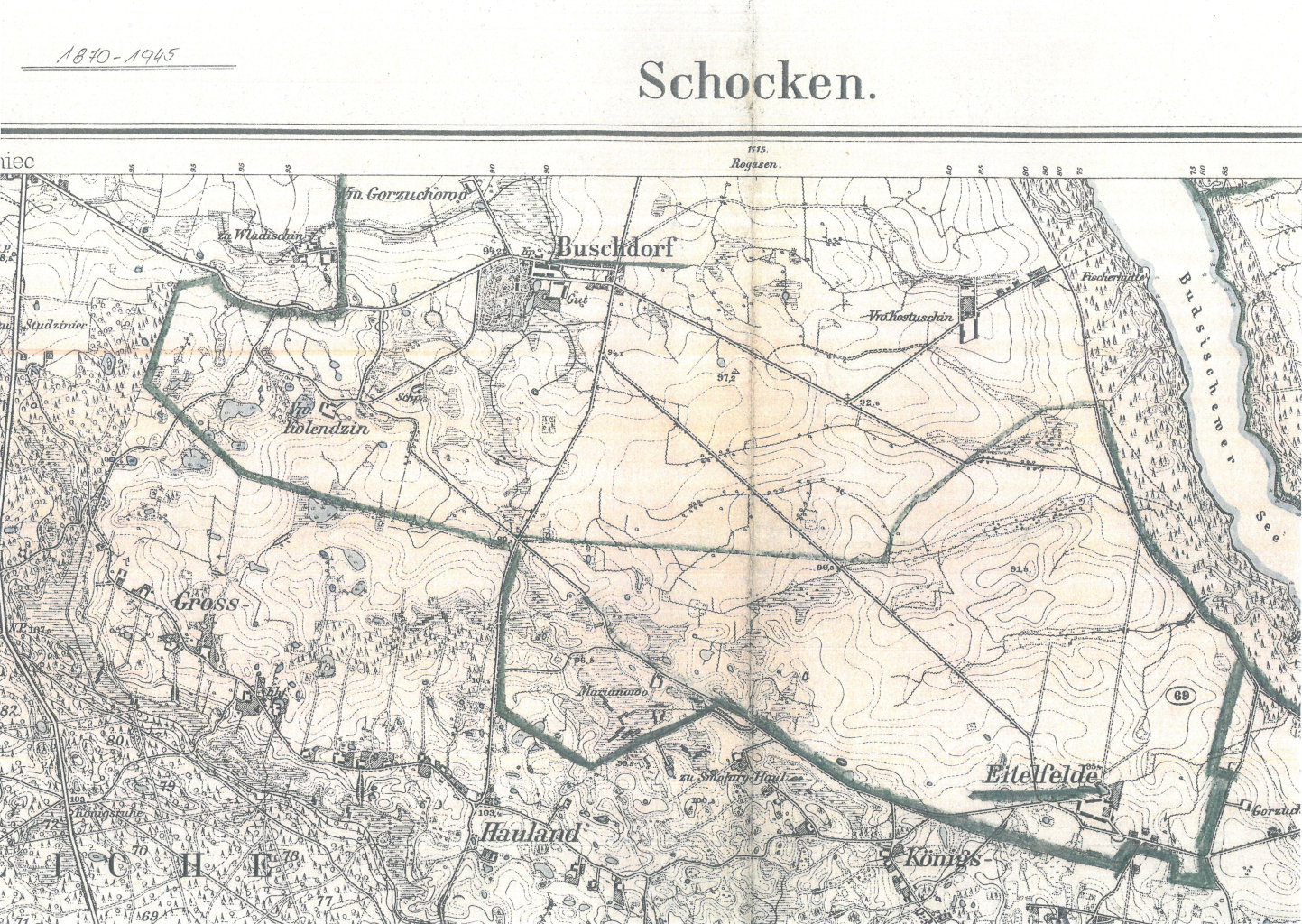
Niemiecka mapa okolic Budziszewka z lat 1870-1945
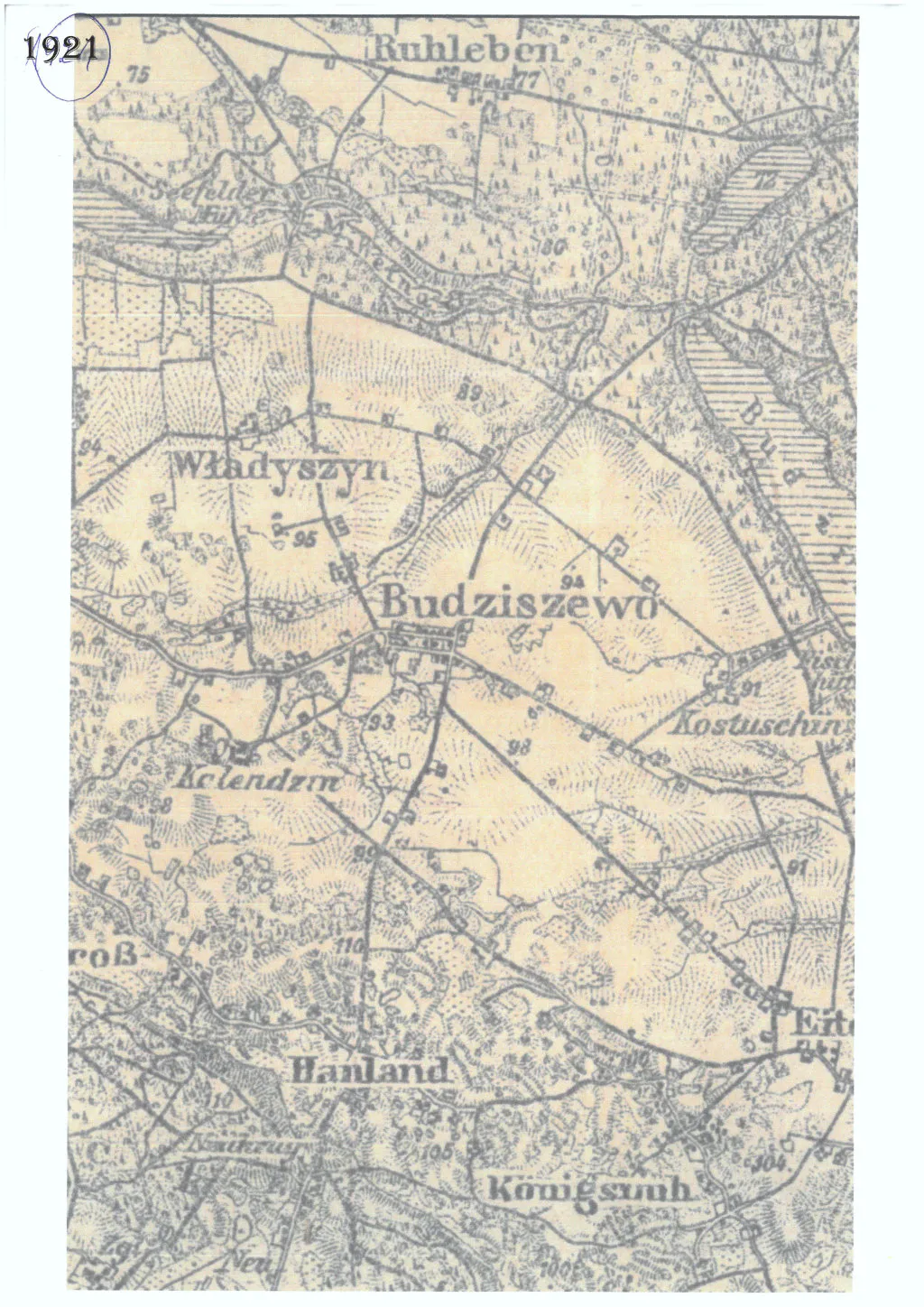
Niemiecka mapa okolic Budziszewka z roku 1920
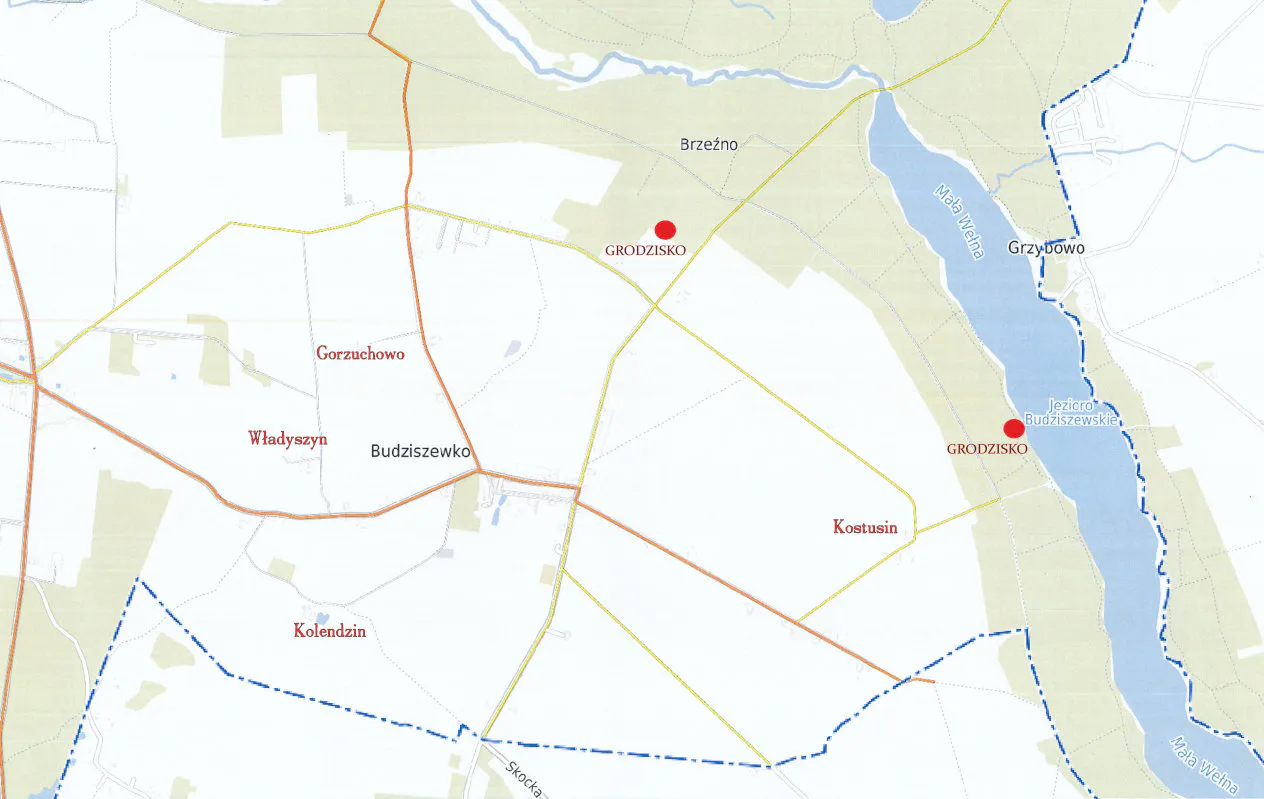
Aktualna mapa Budziszewka z naniesionymi lokalizacjami już nieistniejących miejscowości
Click an image to zoom
 Sołectwo Budziszewko